Showing posts with label Smart Building. Show all posts

Tuesday, April 2, 2019

Smart Building market growth and status "detailed" in a new research report

The smart building market is expected to grow from an estimated USD 7.42 Billion in 2017 to USD 31.74 Billion by 2022, at a Compound Annual Growth Rate (CAGR) of 33.7% from 2017 to 2022. The market is primarily driven by the growing demand for integrated security and safety systems and increasing government initiatives for smart building projects.


Based on type, the services segment is expected to witness the highest growth rate during the forecast period
Based on type, the services segment is projected to grow at the highest CAGR during the forecast period. This is due to the reason that service providers help in implementing intelligent automation and technologies for the efficient operation and maintenance of buildings in a cost-effective manner. The services included in the smart building market study are training & consulting, integration, and support offered by various vendors in this market. These services are considered as added offerings from technology vendors and services providers in the smart infrastructure ecosystem, which enhance the deployment and usage of solutions at end user premises.
Based on building type, the residential building segment is expected to grow at the highest CAGR during the forecast period
Based on building type, the residential building segment is expected to grow at the highest CAGR due to the ability of communication standards and protocols to integrate various control devices and minimize the use of wires due to the emergence of wireless technologies.
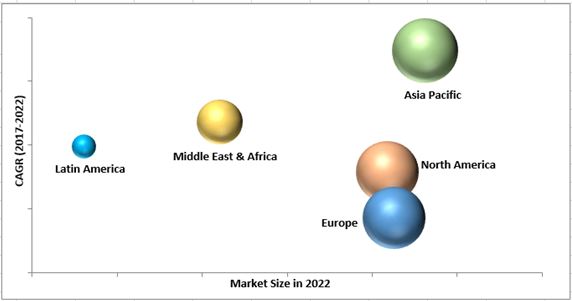
Based on region, Europe is expected to account for the largest market share in the smart building market during the forecast period from 2017 to 2022
Europe is expected to account for the largest market share during the forecast period due to the increased initiatives by the region’s governments to build smart and intelligent structures. Also, the increase in the adoption of energy management as well as security solutions has led to the growth of the smart building market across regions.
The report encompasses the competitive landscape, which presents the positioning of 25 key vendors of smart building solutions and services, based on their product offerings and business strategies. Some of the major solution and service vendors include the ABB Group (Switzerland), Siemens AG (Germany), Schneider Electric (France), Cisco Systems, Inc. (US), International Business Machines Corporation (US), Delta Controls (Canada), Johnson Controls (US), Honeywell International Inc. (US), United Technologies Corporation (US), Legrand (France), BuildingIQ (US), Echelon Corporation (US), Hitachi, Ltd. (Japan), and Panasonic Corporation (Japan) among others.

Friday, December 7, 2018

Smart Building Market worth 31.74 Billion USD by 2022

According to new market research report "Smart Building Market by Type (Building Automation Software, Services), Building Type (Intelligent Security System, Building Energy Management System, Infrastructure Management, and Network Management System), and Region - Global Forecast to 2022", The smart building market is expected to grow from an estimated USD 7.42 Billion in 2017 to USD 31.74 Billion by 2022, at a Compound Annual Growth Rate (CAGR) of 33.7% from 2017 to 2022. The market is primarily driven by the growing demand for integrated security and safety systems and increasing government initiatives for smart building projects.

Know More@ https://www.marketsandmarkets.com/Market-Reports/smart-building-market-1169.html

The smart building market has been segmented on the basis of type, building type, and region. Based on type, the market has been further classified into building automation software and services. The services segment is expected to grow at the highest CAGR during the forecast period. Based on building type, the market has been segmented into manufacturing facilities, residential buildings, commercial buildings, university, school & hospital buildings, government & public infrastructure facilities, and others. The commercial building segment is expected to account for the largest market share during the forecast period. The market has been studied for North America, Europe, Asia Pacific, Middle East & Africa, and Latin America.
On the basis of region, Europe is expected to account for the largest market share during the forecast period. This is due to increased initiatives by the region’s governments for building smart and intelligent structures. Moreover, in Europe initiatives to further push smart and zero energy buildings, with mandatory changes to country level building codes and the Energy Performance of Buildings Directive (EPBD), are expected to enhance existing infrastructure and lead to the growth of the smart building market.
Smart Building Market
Factors that affect market growth include the high initial investment costs for a smart building. Thus, the high initial costs involved in the design and installation of building automation is a major restraint for building owners or buyers with respect to the smart building concept. Building owners and end users often do not realize that the cost is primarily dependent on the complexity involved in integrating different applications. However, growing efforts by manufacturers, facility managers, and governments to increase customer awareness of the long-term benefits of installing building automation systems are expected to reduce the impact of this restraining factor in future. Key players in the smart building market include ABB Group (Switzerland), Siemens AG (Germany), Schneider Electric (France), Cisco Systems, Inc. (US), International Business Machines Corporation (US), Delta Controls (Canada), Johnson Controls (US), Honeywell International Inc. (US), United Technologies Corporation (US), Legrand (France), and BuildingIQ (US).
These companies are focusing on developing smart building solutions and services by adopting various growth strategies, such as partnerships and collaborations, contracts, mergers and acquisitions, new product launches, and business expansions to increase their market shares in the smart building market.
To speak to our analyst for a discussion on the above findings, click Speak to Analyst